
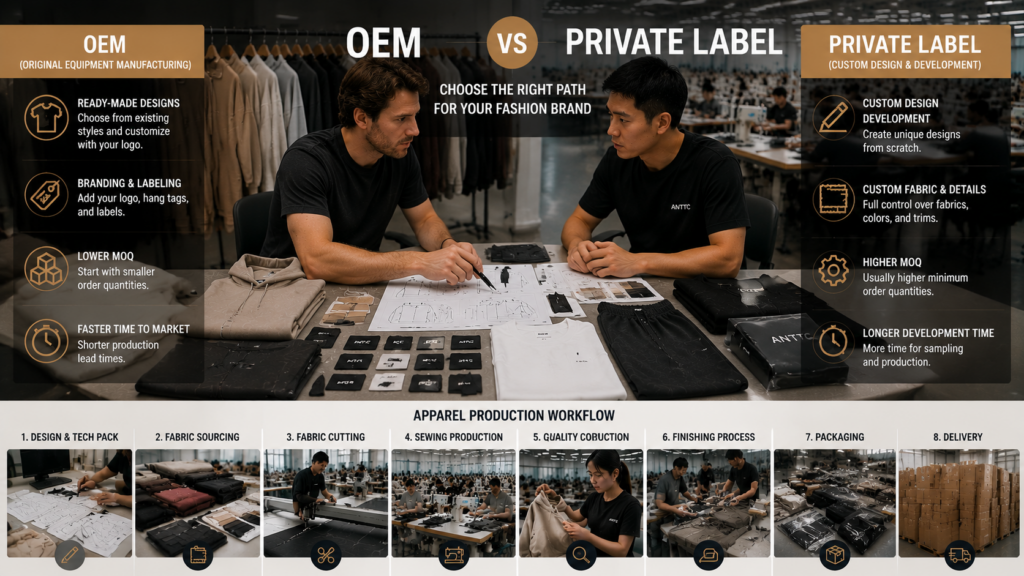
Private Label Clothing Manufacturer vs OEM: What Is the Difference?
When starting a clothing brand, many entrepreneurs hear terms like OEM, ODM, and private label manufacturing.
Although these terms are often used interchangeably, they represent different production approaches.
Understanding the difference between a private label clothing manufacturer and OEM manufacturing can help brands choose the right production strategy, reduce development risks, and build better products.
What Is a Private Label Clothing Manufacturer?
A private label clothing manufacturer produces garments that are sold under a brand’s own name.
The manufacturer handles production while the brand focuses on:
- Branding
- Marketing
- Sales
- Customer Development
Private label production is commonly used by startups that want to launch apparel collections without building their own factory.
Examples include:
- Custom Labels
- Custom Packaging
- Brand Tags
- Selected Product Adjustments
This approach allows brands to enter the market faster.
What Is OEM Clothing Manufacturing?
OEM stands for Original Equipment Manufacturing.
In OEM production, the manufacturer creates products according to the customer’s specifications.
Brands usually provide:
- Design Concepts
- Tech Packs
- Reference Samples
- Fabric Requirements
- Size Specifications
The factory then develops and produces the garments based on these requirements.
OEM manufacturing is ideal for brands that want more control over product details.
Private Label vs OEM: Key Differences
The main difference is the level of customization.
Private Label Manufacturing
Usually provides:
- Faster Product Launch
- Existing Product Development
- Brand Customization
- Lower Development Complexity
It is suitable for brands that want to enter the market quickly.
OEM Manufacturing
Usually provides:
- Full Product Customization
- Unique Designs
- Custom Fabric Selection
- Custom Fit Development
It is suitable for brands that want unique products and stronger brand identity.
Which Option Is Better for New Clothing Brands?
There is no single answer.
The best option depends on the brand’s goals.
Private label may be suitable when:
- Testing a New Market
- Launching Quickly
- Starting With Limited Investment
OEM may be better when:
- Creating Unique Products
- Building Long-Term Brand Value
- Developing Signature Styles
Many successful brands begin with smaller OEM projects and expand their collections as demand grows.
Why OEM Manufacturing Is Popular in Streetwear
Streetwear brands often require unique product details.
Examples include:
- Oversized Fits
- Heavyweight Fabrics
- Special Washing Effects
- Custom Embroidery
- Unique Printing Techniques
OEM manufacturing allows brands to control these details and create products that are difficult to copy.
Common Mistakes When Choosing a Manufacturing Model
Many new brands choose the wrong production method because they focus only on price.
Common mistakes include:
- Selecting Products Without Understanding Their Market
- Ignoring Sample Development
- Choosing Based Only on MOQ
- Not Considering Future Growth
A good manufacturing strategy should consider both current needs and future expansion.
MOQ Differences Between Private Label and OEM
MOQ depends on product complexity.
Typical ranges include:
- 50 Pieces for selected custom styles
- 100 Pieces for standard production
- 300+ Pieces for more complex customization
Products requiring special fabrics, dyeing, or advanced processes may require higher quantities.
How to Choose the Right Manufacturing Partner
Brands should evaluate:
- Manufacturing Experience
- Product Quality
- Communication
- Sampling Process
- Customization Ability
- Quality Control
A reliable manufacturer should help brands understand the best production solution instead of simply accepting orders.
Why Long-Term Manufacturing Relationships Matter
Successful brands usually develop long-term relationships with manufacturing partners.
Benefits include:
- Better Product Consistency
- Faster Development
- Improved Communication
- More Efficient Production
As manufacturers understand a brand’s expectations, future collections become easier to develop.
Conclusion
Private label and OEM manufacturing both provide valuable opportunities for clothing brands.
Private label is often suitable for faster market entry, while OEM manufacturing provides greater customization and product control.
Understanding the difference allows brands to choose the right production method and build stronger apparel collections.
Looking for a Private Label Clothing Manufacturer or OEM Partner?
Ludika specializes in:
✔ Private Label Clothing Production
✔ OEM Streetwear Manufacturing
✔ Activewear Manufacturing
✔ Custom Hoodies, T-Shirts, Joggers & Yoga Wear
✔ Custom Labels & Packaging
Contact us today to discuss your clothing brand project.